
Konami · 1992 · Arcade history
The history of Konami X-Men
How Konami’s 1992 beat ’em up brought six mutants together, built a remarkable dual-screen cabinet, and found its way back to modern consoles.
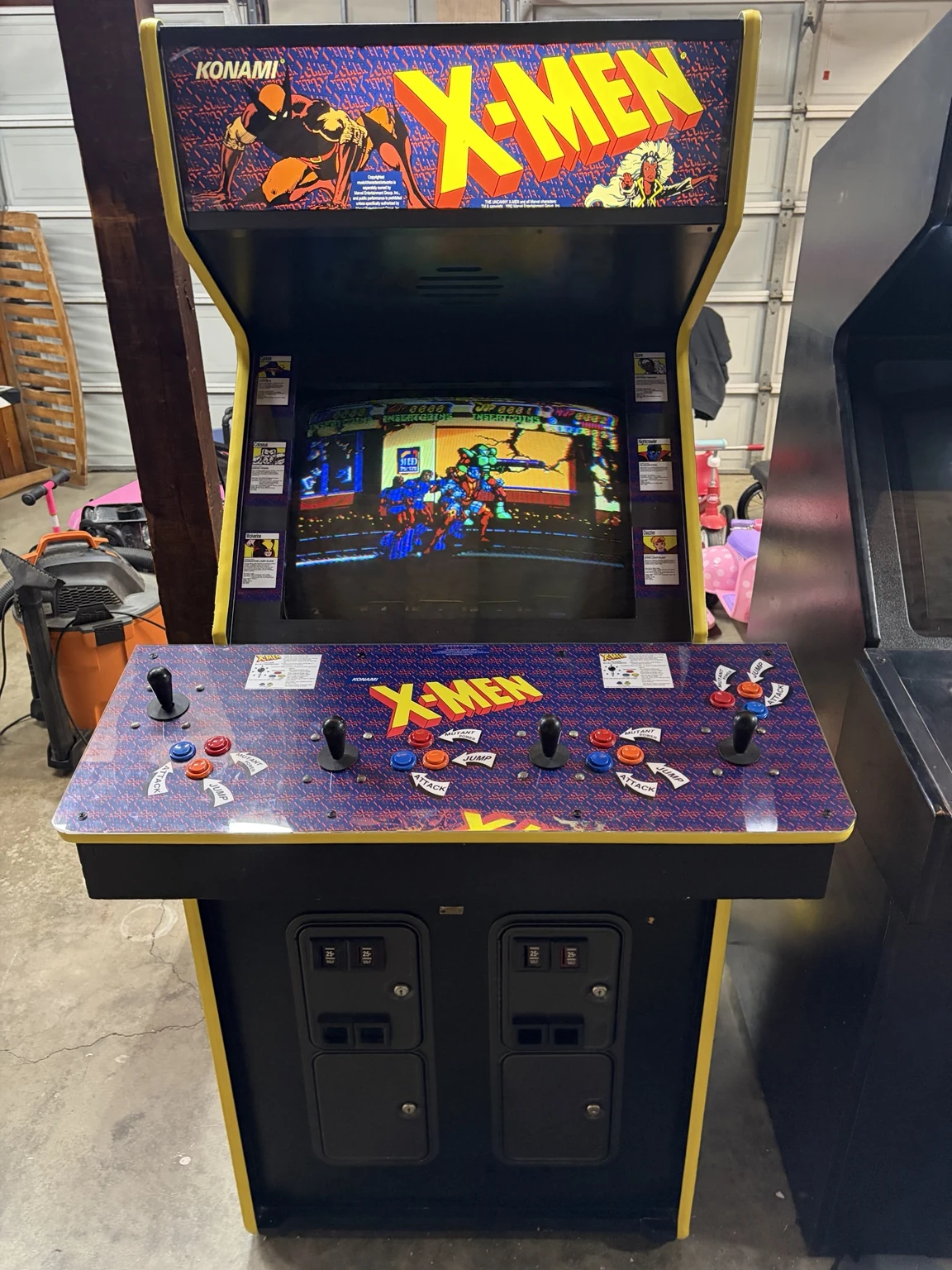
Six people, two screens and a control panel wide enough to start an argument over who gets Wolverine. Konami’s 1992 X-Men made a strong first impression before anybody inserted a coin. Its biggest cabinet turned a superhero team into something you could actually assemble with the people standing beside you.
The four-player version deserves just as much attention. It delivered the same basic invitation in a more manageable package: pick a mutant, jump into the fight and help clear the screen. The attraction was easy to understand even if you had never opened an X-Men comic.
Behind that immediate appeal is a surprisingly interesting history. The game preserved the cast of an earlier animated pilot, stretched Konami’s multiplayer beat ’em up formula across a remarkable cabinet, and waited eighteen years for a console release. Its later disappearance from digital shops, followed by a new return in 2026, adds another chapter to a game collectors have spent decades keeping alive.
Konami builds a bigger team
By the early 1990s, Konami had established a recognizable approach to licensed arcade action. Its Teenage Mutant Ninja Turtles and The Simpsons games put familiar characters into colorful, side-scrolling fights built for friends to join together. The Simpsons, released in 1991, offered four-player cooperative action, with each member of the family bringing a different way to hit somebody. The Simpsons at the Museum of the Game
X-Men was a natural fit for that style. A team of visually distinct heroes made the controls approachable while giving each player a reason to care about their choice. Konami developed and published the arcade game in 1992, and the deluxe version let all six playable characters fight simultaneously. The original promotional flyer put that six-player format directly in its sales pitch. Konami’s original X-Men flyer
The appeal went beyond adding two extra joysticks. A crowded cabinet changed the atmosphere around the game. Someone could watch for a minute, recognize a character and take the next open position. A group could lose track of the plot and still understand the immediate job: get that enormous enemy away from your friend.
That is also why X-Men remains easy to demonstrate. There is very little explanation between “this is your character” and a room full of people making noise.
The cartoon connection comes before the famous cartoon
The familiar date can be misleading. X-Men: The Animated Series first appeared on Fox on October 31, 1992. Konami’s game drew on an earlier production, the 1989 pilot Pryde of the X-Men. In a later oral history, animation director Larry Houston recalled working on that unsuccessful pilot before the Fox series came together. The creators’ television oral history
The game’s connection to Pryde is explicitly confirmed by Marvel licensed-games manager Chris Baker in a 2010 retrospective. It explains why this particular team looks different from the lineup associated with the later television show. Marvel’s Chris Baker on the arcade game
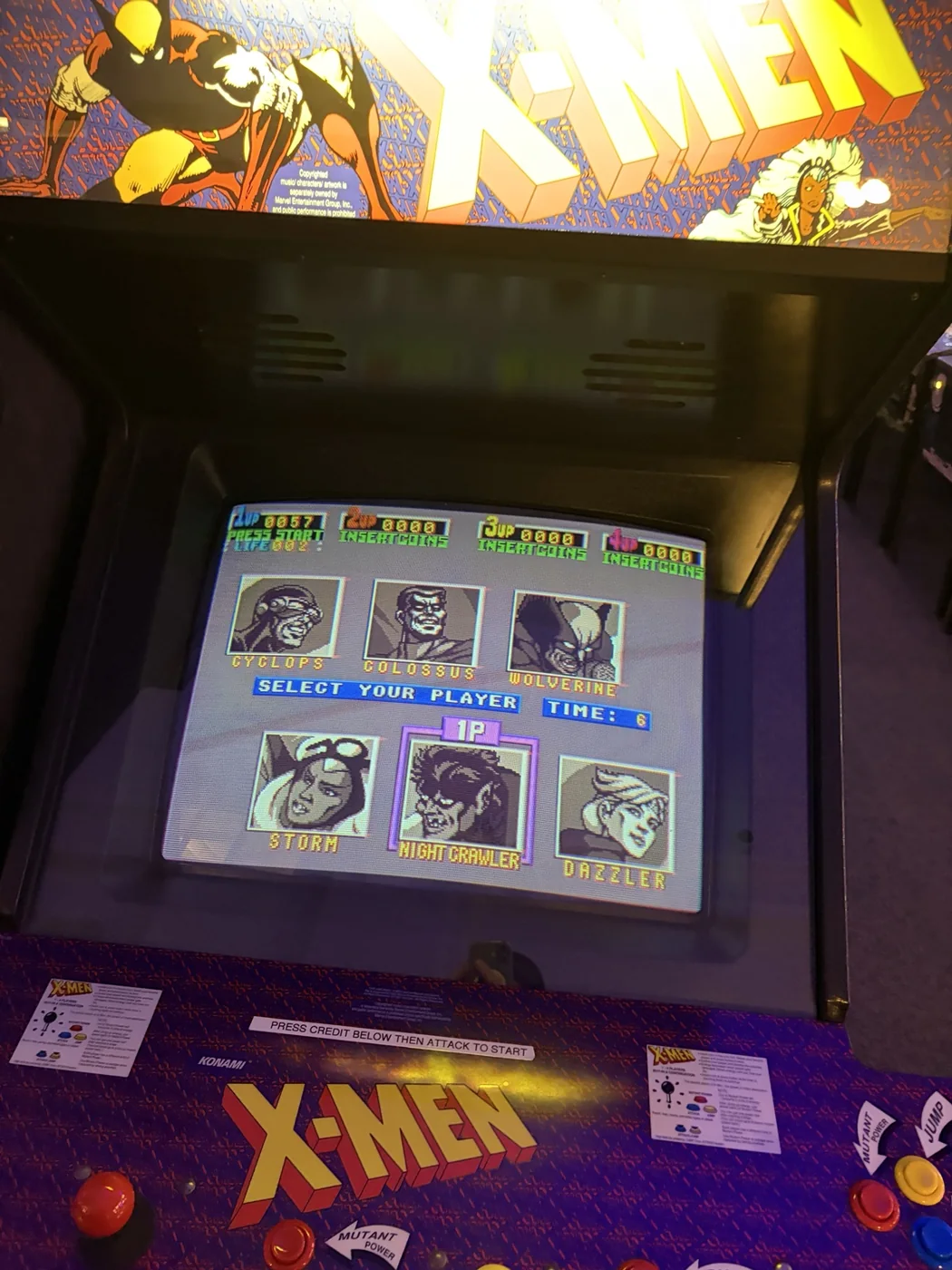
Players choose Cyclops, Colossus, Wolverine, Storm, Nightcrawler or Dazzler. Konami’s artwork gives them instantly readable silhouettes and contrasting colors. Wolverine wears his brown-and-yellow costume; Nightcrawler is blue and red; Colossus is hard to mistake for anybody else. Dazzler gets a full place on the team rather than a background cameo. The cast is right there on the original flyer, which also describes the mission to rescue Professor X and Kitty Pryde and pursue Magneto to Asteroid M. Konami’s character art and story summary
The result is a playable time capsule of an X-Men adaptation that never became a full television series. That gives the game a slightly different identity from the many later adaptations, even before its first punch lands.
Two players, four players, and the enormous six-player cabinet
X-Men existed in two-, four- and six-player configurations. MAME’s preservation documentation records these as distinct versions, with differences in coin handling and cabinet requirements. It is worth remembering that “the X-Men arcade machine” does not describe one universal setup. MAME’s X-Men hardware and version documentation
The four-player dedicated cabinet used one 25-inch monitor. It also provided an on-screen character selection process, so four controls did not mean the game was reduced to a four-character roster. Konami’s instructions tell players to choose their character with the joystick before starting. Konami’s four-player instruction manual
The six-player cabinet was a different physical proposition. Two CRT monitors combined into a broad playing field. One display was viewed directly; the image from the other, mounted lower in the cabinet, was reflected by a mirror. This arrangement brought the pictures together without putting the bulky edges of two CRT assemblies side by side in the players’ view. Konami’s manual lists the mirror and 25-inch monitor hardware and illustrates the separate rear monitor assembly. Konami’s six-player instruction manual
The controls were tied to particular heroes. To choose a character, you moved to that character’s station and used the corresponding coin slot. The six-player manual is wonderfully direct about this. It also identifies attaching the rear monitor as a two-person job, a useful reminder that this was substantial furniture as well as an arcade game. Six-player controls and cabinet assembly
For players, the extra width gave the team room to spread out. For collectors, it created a machine whose display arrangement is part of the attraction. Keeping two pictures aligned and visually matched is part of preserving the effect that made it special.
Watch the heroes in action
A quick burst of Konami’s X-Men: Cyclops’ optic blast, Wolverine’s claws, Storm’s tornado and Colossus’ energy burst.
Video description
Professor X appears with the on-screen message “Go and Save the City!” The montage then shows Cyclops firing an optic blast, Wolverine striking with his claws, Storm using a tornado, and Colossus releasing an energy burst, followed by the team finale. On-screen labels identify each featured character. Original game music and effects accompany the action.
A soundtrack with its own identity
X-Men’s sound deserves attention beyond Colossus making himself heard. There is unusually useful firsthand evidence about its creation. In a 2009 interview, composer and sound designer Yuji Takenouchi identified X-Men as his first arcade project and credited Seiichi Fukami with establishing its sound concept. Takenouchi described contributing rhythm programming, FM sampling and sound-design work. Yuji Takenouchi’s interview
He also discussed the practical difference between making music for home computers and for arcades. His account of Konami’s arcade work describes taking sounds into actual arcades for location tests, where they had to work amid a much less controlled listening environment.
That context suits X-Men. Its energetic rhythms, forceful effects and short voice clips all have jobs to do while players concentrate on a busy screen. The soundtrack helps give the game an identity of its own, separate from the television theme that many people now associate with the characters.
What operators thought in 1992
Contemporary trade coverage helps separate the original response from decades of nostalgia. In Play Meter’s April 1992 issue, Baton Rouge operator Jim Overman included X-Men in his trade-show picks. He awarded it 91 out of 100 in his rating system and 10 out of 10 for his separate gut-feeling score. Those are one operator’s judgments, but they are an unusually clear snapshot of enthusiasm at the time. Play Meter, April 1992, ACME supplement page 52
Later that year, Cash Box listed X-Men among the Amusement & Music Operators Association award nominees for both the most-played dedicated video game and the most innovative new technology. A nomination does not establish a sales total or an annual earnings rank, but it does show recognition from the coin-operated amusement industry while the game was new. Cash Box, August 29, 1992, page 29
The combination makes sense: X-Men offered familiar, accessible action inside an unusually ambitious machine. The cabinet gave operators something conspicuous to put on the floor, while the multiplayer format gave a group a reason to stay together around it.
The long trip home and the return in 2026
The arcade game finally reached home consoles in December 2010. In North America, the PlayStation Network release arrived on December 14, followed by Xbox Live Arcade on December 15. Marvel’s launch retrospective noted the eighteen-year wait. PlayStation’s launch article · Xbox’s release announcement
Online multiplayer made assembling a team possible without finding an original cabinet. Sony’s announcement specifically confirmed six-player local or online support on PlayStation 3. The rerelease also included American and Japanese versions, making the different power systems more accessible to players who had only encountered one in arcades. Sony’s 2010 announcement · Rerelease version details
The digital release did not remain permanently on sale. By the turn of 2014, contemporary reporting documented X-Men’s removal from the Xbox Games Store. Licensing was suggested as the explanation, but no official reason was given in that report. TrueAchievements’ January 2014 report
There is now a happier continuation. MARVEL MaXimum Collection arrived on March 27, 2026, bringing X-Men: The Arcade Game to current platforms. Limited Run Games lists Switch, PlayStation 5, Xbox Series and Steam, while the official PlayStation listing confirms six-player online play with rollback netcode. Limited Run’s collection announcement · Official PlayStation listing
That return matters. A new audience can play the game without owning a cabinet, and longtime players have another way to bring a group together. The history no longer ends with a missing purchase button.
Keeping the original machine alive
For a collector, X-Men’s attraction includes everything surrounding the software. The cabinet artwork, colored controls, CRT image and physical spacing between players all contribute to the experience. A four-player machine has an especially useful balance: enough room for a small group, with fewer display complications than the enormous six-player cabinet.
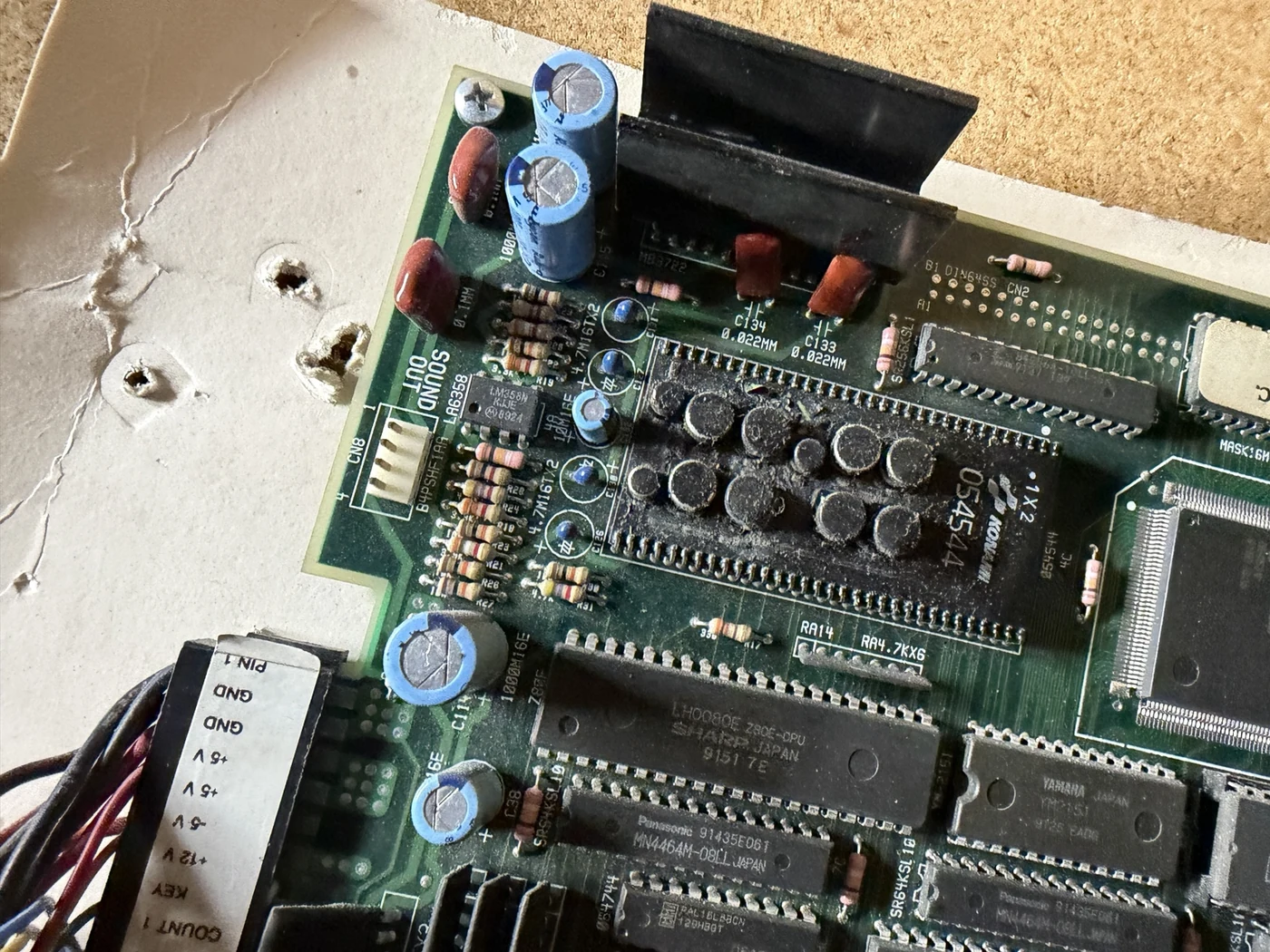
Restoration brings those details into focus. Worn controls change how the game feels. Damaged artwork changes how it looks across a room. Audio faults can remove much of its character even while the picture seems fine. A machine that boots still deserves a careful look at how it actually plays.
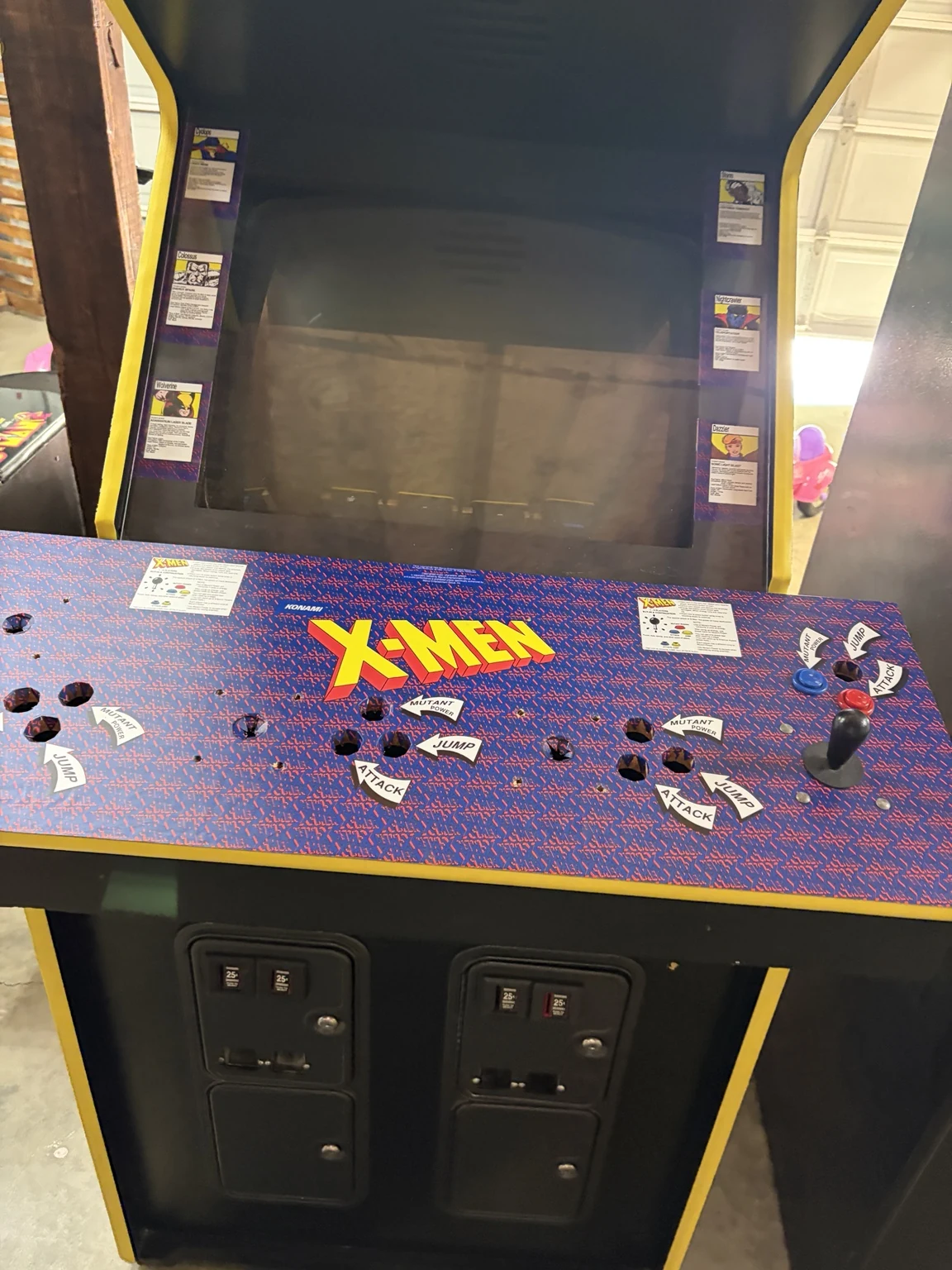
My own X-Men is the four-player version. The restoration has included rewiring, board service to repair the audio, new artwork, new T-molding and a new acrylic cover for the control panel. Monitor curl was also part of the troubleshooting along the way. Those jobs are a useful reminder of how many separate pieces have to come together to make an old arcade cabinet feel right again.
For the six-player version, the distinctive display adds another reason to preserve original parts and document changes carefully. Its mirror arrangement belongs to the machine’s history. The smaller versions deserve the same attention to their own construction and controls; they are part of how X-Men reached different arcades and different groups of players.
More than thirty years later, the invitation is still easy to understand. Pick a character, take your place and help the people beside you get through the next fight. Konami built a machine around that shared moment. Every restored cabinet gives it another chance to happen.
Selected sources
- Konami’s original four-player and six-player manuals and 1992 sales flyer, linked above, provide cabinet, control, roster and gameplay evidence.
- Marvel’s Chris Baker, PlayStation Blog, December 13, 2010, confirms the Pryde connection and discusses the game’s distinctive powers and dialogue.
- Chris Greening’s interview with Yuji Takenouchi, October 2009, provides firsthand sound-development recollections.
- Play Meter, April 1992, ACME supplement page 52, and Cash Box, August 29, 1992, page 29, document contemporary operator response and award nominations.
- Official PlayStation and Xbox announcements document the 2010 home release; Limited Run and the PlayStation Store document the 2026 collection.
Sources checked October 10, 2026. Photographs: Matt Pearce / Classic Coinworks, from previously published cabinet stories.