
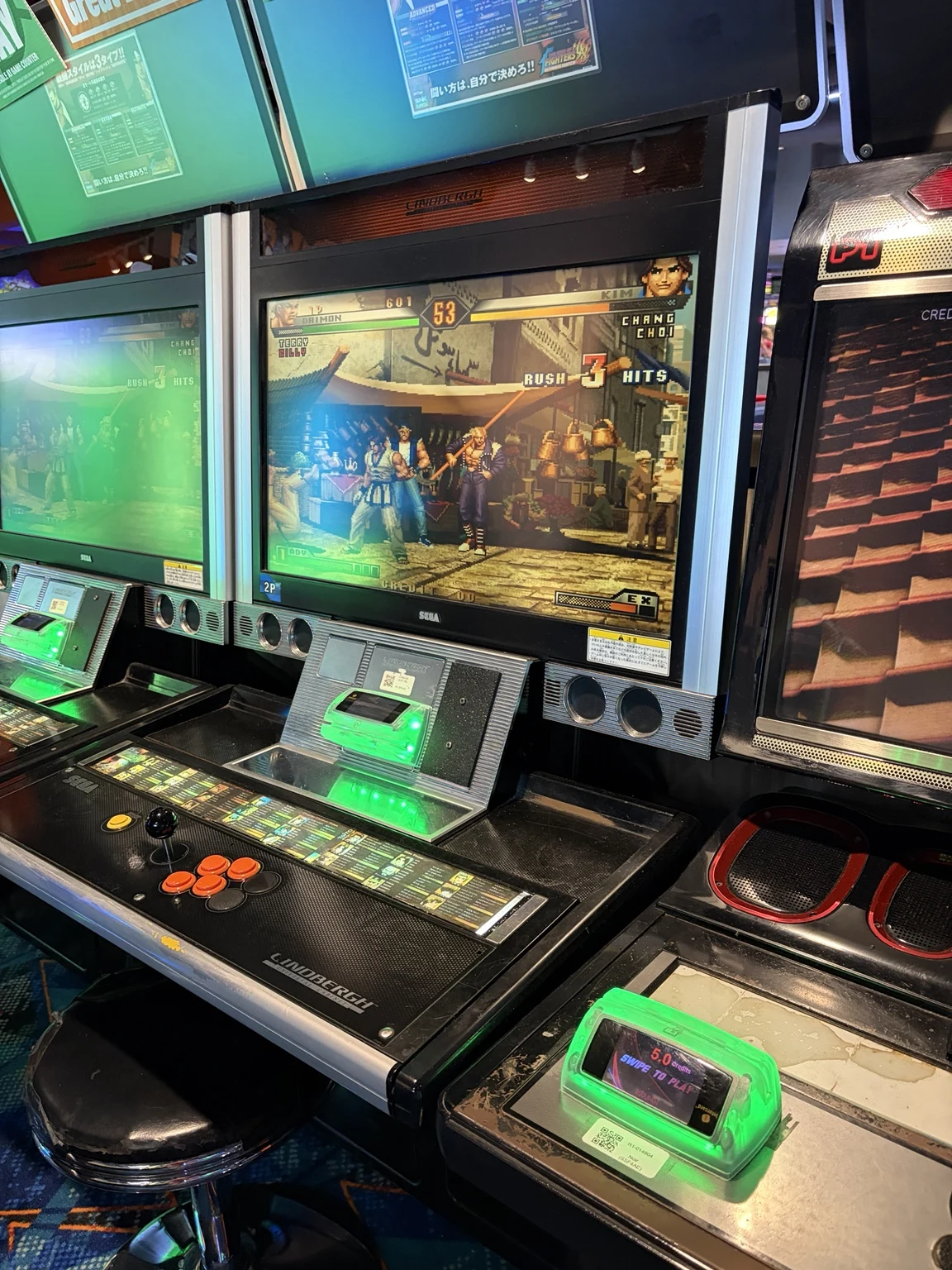
A stool, a wide control panel, and a screen right in front of you. Japanese sit-down cabinets make an arcade feel different before you even press Start.
My photos here show two later examples: a Sega cabinet carrying Lindbergh branding and a Namco Noir Cabinet HD. They are a good starting point for understanding the candy-cab idea—and why the cabinet’s identity and the game on its screen are two separate things.
What is a candy cab?
“Candy cab” is a collector nickname for a family of Japanese arcade cabinets, usually associated with sit-down play and a cabinet designed to host different games. It is not a single manufacturer, game, or wiring standard. The classic image is a light-colored cabinet with a curved shell, a CRT, and a low control panel.
The cabinet supplies the playing environment: screen, speakers, controls, power, and coin handling. The game hardware inside determines what you play. That modular idea is part of the appeal. You can love the cabinet itself even when your favorite game changes.
Not every Japanese cabinet is white, made from the same material, or equipped with the same controls. Later LCD designs carry the sit-down, reusable-cabinet idea forward with a very different look.
Astro City and the classic CRT look
Sega’s Astro City is a landmark example. Sega dates its introduction to 1993 and describes its resin construction as a departure from its earlier sheet-metal cabinets. The company says roughly 50,000 were installed in Japanese game centers. [1]
That rounded, light-colored shape is what many collectors picture when someone says candy cab. The monitor sits close to the controls, and the cabinet looks more like a purpose-built playing station than a tall wooden billboard.
Names you will encounter include Sega Astro City, New Astro City, and Blast City, and SNK’s Neo Geo Candy cabinets. Treat each as a model to investigate, rather than assuming every “candy” listing has the same monitor, panel, or internal setup.
My photos: the later LCD generation
Sega Lindbergh
The Sega branding is visible on the monitor surround and control panel in my photo. Notice the stool, the separate instruction display above the screen, and the broad panel below it. Those details show how the cabinet organizes the experience around a seated player.
Sega’s 2007 Lindbergh Universal manual documents a widescreen LCD cabinet, replaceable control panels, and game-board replacement procedures. That manual covers the UK upright version; its dimensions and power specifications should not be applied to the seated cabinet in this photo. [2]
The lesson is bigger than the label: a cabinet can host a game from a different hardware family after conversion. A Lindbergh badge does not prove that a Lindbergh computer is still running inside.
Namco Noir Cabinet HD
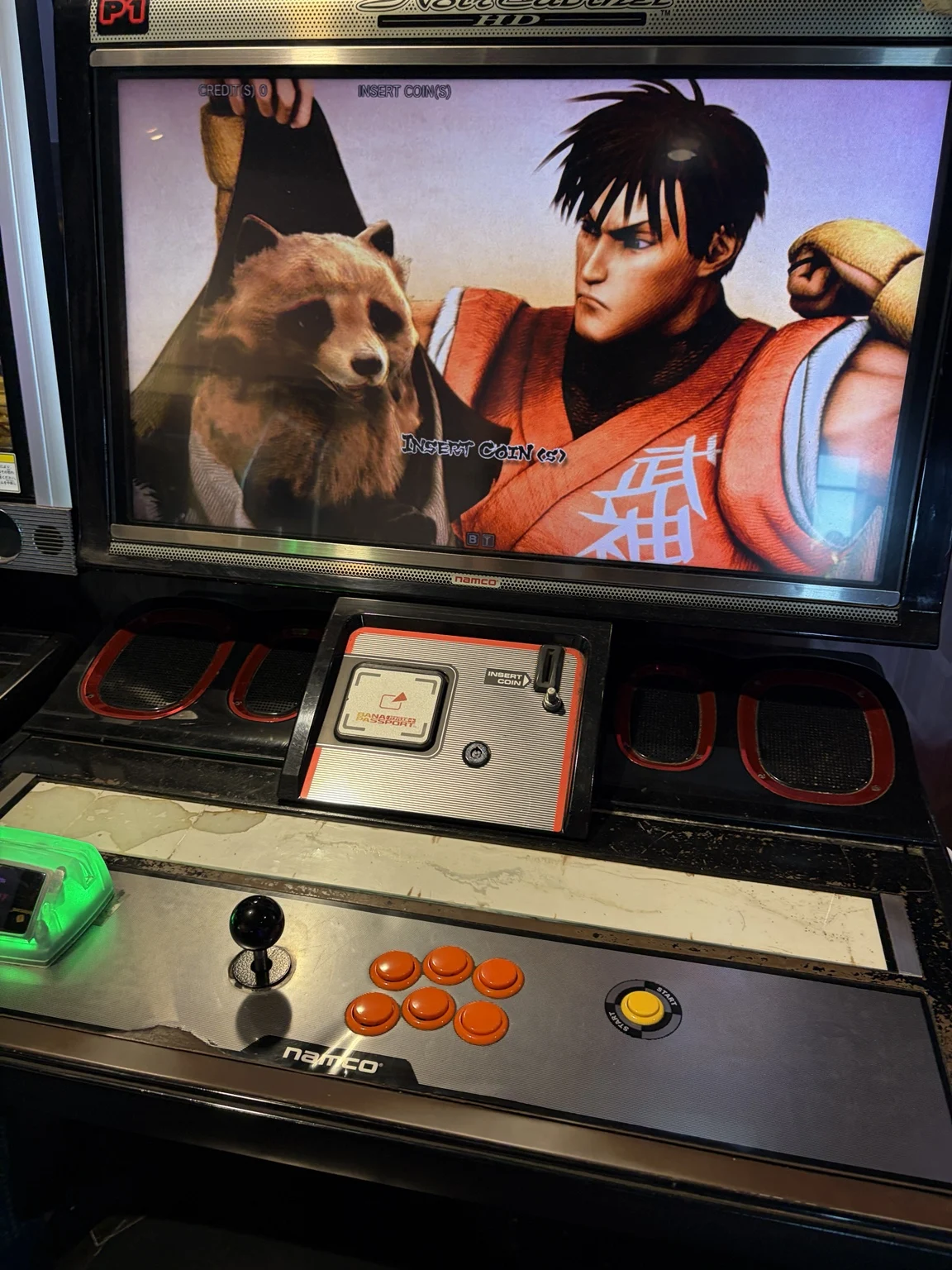
The second photo shows the Noir Cabinet HD name above the screen and Namco branding below it. Its darker shell, widescreen display, and speaker arrangement are a different visual language from an Astro City, but the stool-height playing position is familiar.
The Namco Tekken 6 operation manual preserved with Noir documentation also illustrates why the game manual and the cabinet manual are separate resources: it refers operators to the cabinet’s own operation manual for panel access. Keep both when researching a machine. [3]
Candy cabinet versus a wooden upright
| What you notice | Typical candy-style setup | Typical wooden upright |
|---|---|---|
| Playing position | Often seated on a stool | Often standing |
| Visual identity | Cabinet model stays recognizable as games change | Dedicated game artwork can define the whole machine |
| Controls | Often a removable metal panel | Panel material and layout vary by cabinet |
| Display | Classic CRT models and later LCD models | Original CRTs and converted displays both exist |
These are tendencies, not rules. A converted wooden cabinet can host multiple games, and a Japanese cabinet can have unusual controls or an altered display. My X-Men cabinet and these sit-down machines offer different ways to enjoy the same arcade habit.
What I would check before buying one
- Identify the shell and the hardware separately. Get the model plate, board labels, monitor model, and clear interior photos. The game on the screen is only one part of the purchase.
- See it running from a cold start. Check the whole picture, sound, every direction, every button, and credit input. A single attract-mode photo cannot show all of that.
- Confirm display and wiring compatibility. JAMMA and JVS are different interfaces. Identify the harness, I/O board, adapters, and the monitor’s accepted signals before planning a board swap.
- Inspect the parts that are hard to replace. Look for shell cracks, corrosion, missing doors, damaged panels, and absent mounting hardware. Pretty new buttons do not fix a damaged cabinet.
- Plan the move. Measure the cabinet, doorways, turns, and vehicle opening. Confirm the actual electrical requirements from its labels and manual, particularly on an imported machine.
For CRT work or electrical diagnosis, use a qualified technician. A cabinet being unplugged does not make the inside of a CRT safe to handle.
Why I like the idea
A dedicated cabinet makes a game the star. A candy-style cabinet makes the playing station part of the attraction: sit down, put your hands on the panel, and settle into another round.
There is room for both. I like a cabinet with personality, whether that comes from huge X-Men artwork or a clean sit-down layout. The best choice is the one that suits the games you want to play—and the space where you will actually play them.
Keep exploring: cabinet styles and conversions, Sanwa vs. Happ joysticks, and your first arcade machine.
Sources and photo notes
- Sega: Astro City background — manufacturer history on the Astro City Mini site, referring to the original 1993 cabinet.
- Sega Lindbergh Universal Cabinet manual, 2007 — archived manufacturer manual for the UK upright version.
- Namco Tekken 6 operation manual — archived manufacturer documentation, hosted by Hard*Candy.
Photos by Matt Pearce, used with permission for Classic Coinworks. Cabinet names are read from visible branding; exact installed boards, joystick models, and modifications have not been inspected.